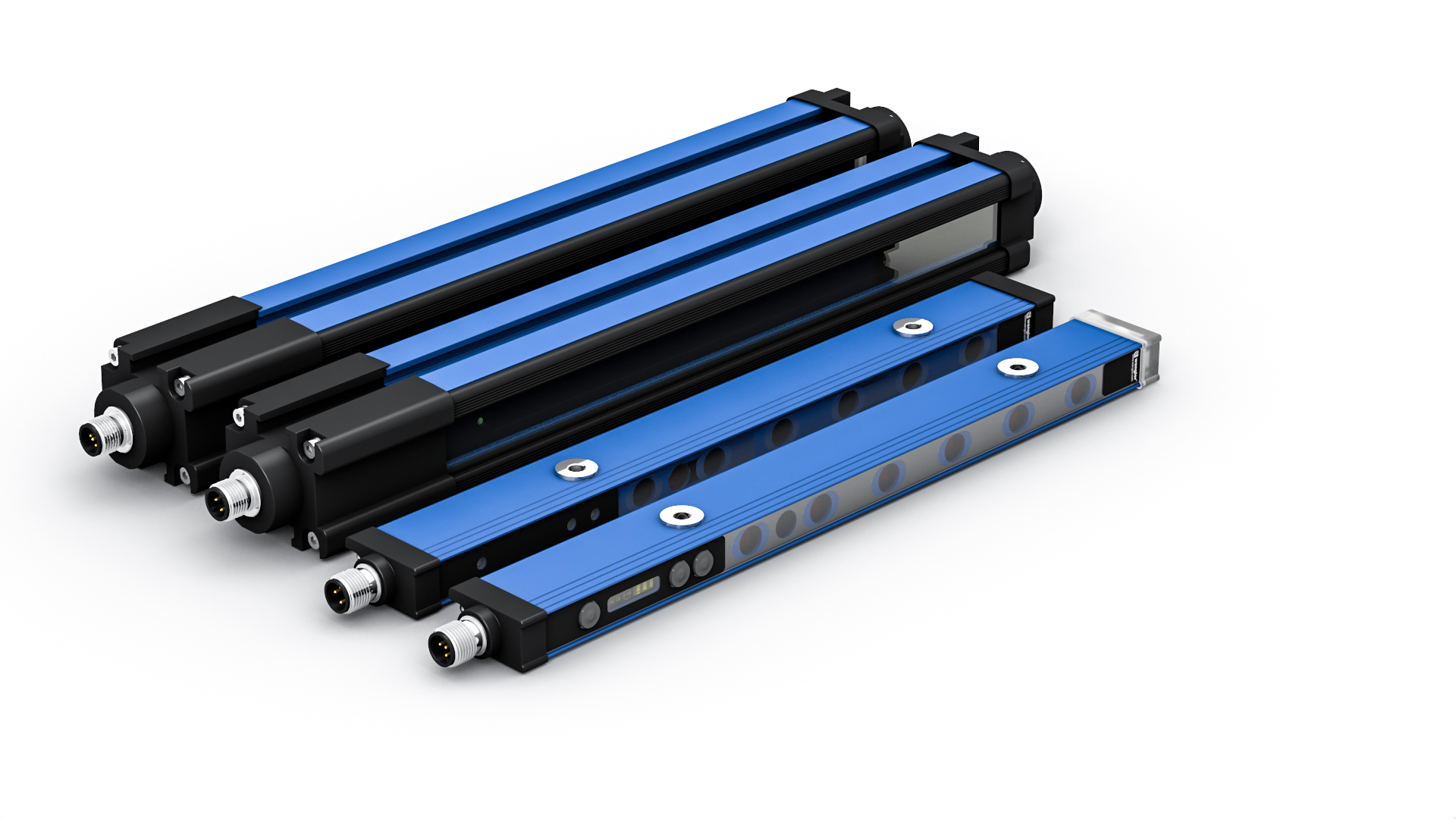
Monitor uniform belt tension with measuring light curtains
The correct tension of the belt material plays a central role in the production of metal mesh, textiles or films. Even minimal slack can impair product quality, lead to uneven mesh formation or disrupt material flow. This is why precise slack monitoring along the entire belt width is crucial for keeping processes stable and reproducible.
Measuring light curtains from wenglor offer a robust and economical solution. They enable continuous monitoring of the belt tension – with a resolution of just two millimetres.
wenglor light curtains reliably measure objects or belt sags across the entire width.
Precise control across the entire width
As the fabric or film is fed through the system, it may sink slightly in the middle area. This effect can hardly be completely avoided, especially with wide material webs. Classic photoelectric switches often do not detect such small deviations accurately enough, and camera systems or profile sensors are often too complex for this type of control.
Measuring light curtains such as the OSEI501Z0103 (emitter) and OEEI501U0135 (receiver) models from wenglor, on the other hand, monitor the entire width of the belt. A dense light curtain of infrared beams is created between the emitter and receiver. If the belt sags too much in the middle area, it interrupts individual beams and the system immediately recognizes that the target state has been left.
Thanks to a beam distance of just two millimetres, detection is very precise. The measurement data can be transmitted directly to the controller via an analog output signal and used to regulate the belt tension.
In the system, the sag of the metal mesh is measured across the entire strip width to ensure the correct tension.
Simple, reliable and economical
Compared to profile sensors or image-based systems, light curtains offer simple integration with high accuracy. The installation effort is low and several modules can be combined even with large bandwidths.
Thanks to the non-contact measurement, the sensors are suitable for a wide range of materials – from stainless steel mesh to plastic and technical textiles.
Another advantage: the system provides a continuous measurement across the entire width instead of just monitoring individual points. This allows the condition of the belt to be assessed in real time and deviations are detected at an early stage.
Making conscious use of technical limits
Measuring light curtains offer an excellent balance between precision and economy, but also have clear limits.
As they work with a fixed beam distance, they cannot localize exactly where the sag occurs. They therefore detect that the sag is present, but not where exactly along the width.
For applications where the exact sag shape or the position of shafts in the material is important, a profile sensor is the better choice. However, if you only want to know whether the belt tension is within tolerance, the measuring light curtains are an extremely efficient solution.
Conclusion
Measuring light curtains such as the OSEI501Z0103 and OEEI501U0135 models enable precise sag monitoring while the belt is running – with minimal installation effort and high measuring accuracy. They offer an economical alternative to profile sensors when it comes to reliably detecting the tension of a fabric, film or metal strip. With a resolution of two millimetres, they ensure that materials are guided evenly and manufacturing processes remain stable across the entire strip width.
To provide you with an optimal experience, we use technologies such as cookies to store and/or access device information. If you consent to these technologies, we may process data such as browsing behaviour or unique IDs on this website. If you do not give your consent or withdraw it, certain features and functions may be affected.
Functional
Always active
Technical storage or access is strictly necessary for the legitimate purpose of enabling the use of a specific service explicitly requested by the subscriber or user, or for the sole purpose of carrying out the transmission of a communication over an electronic communications network.
Preferences
Technical storage or access is necessary for the legitimate purpose of storing preferences that have not been requested by the subscriber or user.
Statistiken
Technical storage or access for statistical purposes only.Technical storage or access used exclusively for anonymous statistical purposes. Without a subpoena, the voluntary consent of your internet service provider, or additional records from third parties, the information stored or accessed for this purpose cannot, as a rule, be used to identify you.
Marketing
Technical storage or access is required to create user profiles, send advertising or track users on a website or across multiple websites for similar marketing purposes.