Reading of the production date and batch number on parquet planks with Deep OCR and B60

In modern parquet plank production, clear and permanently legible marking is indispensable. The batch number and production date are applied to the back of each parquet plank, usually by inkjet printing. This information must remain reliably readable not only for the manufacturer, but also for downstream bodies such as trade, trade or end customers. This is exactly where camera-based quality inspection with Deep OCR comes in.

Production line for parquet planks in a wood factory with CNC machine and conveyor belt.
Industrial parquet plank production with CNC woodworking machines and automated production line – efficiency and precision in parquet floor production.

Importance of marking for parquet and parquet flooring

Batch and date marking forms the basis for complete traceability in parquet production. If defects, colour deviations or technical problems occur later, it is possible to clearly trace when a particular plank was produced and under what conditions this took place. In this way, affected batches can be identified and narrowed down in a targeted manner without triggering large-scale recalls.

In addition, the production date plays an important role in the material behaviour of wood and the adhesives used. Especially in the case of multi-layer and prefabricated parquet, too long a storage period can lead to changes, for example in surface treatments, the aging of varnishes or adhesives, as well as dimensional and fit deviations of the connection systems. In retail, date marking also supports consistent stock rotation according to the first-in, first-out principle in order to avoid quality losses in parquet flooring.

Camera-Based Readability Checking with Deep OCR

To ensure that the batch number and production date are clearly legible at all times, the printing process is monitored immediately after application. The solution is based on a B60 camera combined with deep OCR technology. The camera captures each parquet plank during the ongoing production process and automatically checks whether the printed characters are complete, correct and sufficiently high-contrast.

In contrast to classic OCR processes, Deep OCR is particularly robust against changing print qualities, wood structures and varying surfaces. Incomplete, smeared or incorrect markings are reliably detected and affected planks can be rejected immediately.

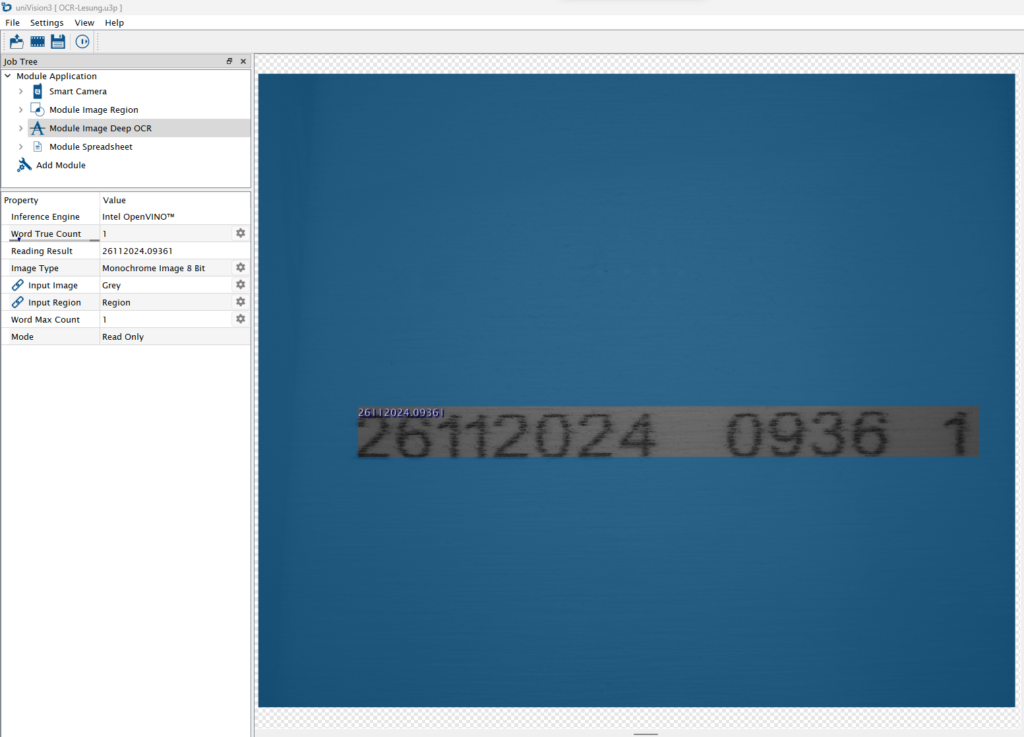
uniVision screenshot: Reading of a clearly visible parquet plank number on a light background.
Deep OCR reliably captures production numbers on parquet floorboards.
uniVision screenshot: Reading of a parquet plank number on a dark gray background with low contrast.
Deep OCR in the uniVision software reliably reads production numbers on parquet floorboards even with low contrast – for error-free marking and traceability.

More process reliability for wood and parquet production

The automated reading of the production date and batch number significantly increases process reliability in parquet production. Incorrect markings are detected at an early stage, the risk of complaints is reduced and traceability is sustainably improved. For manufacturers of parquet planks, this means higher quality assurance, stable processes and more transparency along the entire value chain.

Author

Picture of Max Mustermann

Max Mustermann

Job title